WIN WITH GREYS    Your chance to WIN an Greys rod & reel outfit worth up to £688 - ENTER NOW

  10% OFF ORDERS    Black Friday Early Bird Deal, use code BF25EB for 10% OFF - VIEW DETAILS

 NEW: SPORTFISH PLUS    Earn points, level up and unlock bigger rewards - LOG IN OR JOIN

 SPRING SPECTACULAR    Tune in this weekend to advice, tips, tricks & more - VIEW EVENT INFO

  THE LATEST GEAR     Discover new tackle and clothing from the best brands - BROWSE NOW

  NEW 2026 CATALOGUE     Explore new tackle & clothing from the best brands - REQUEST A COPY

  MID-SEASON SALE: UP TO 50% OFF    Grab a bargain on selected tackle & clothing - SHOP SALE

  UP TO 15% OFF SELECTED BRANDS*    10% code WFFD10 or 15% OFF £250+ code WFFD15 - DETAILS

  FESTIVE DEALS    10% OFF* use code XMAS10 or 15% OFF* orders £250+ use code XMAS15 - VIEW TERMS*

  JANUARY SALE NOW ON    Save at least 30% OFF top brands - SHOP NOW

  LAST-MINUTE GIFTS    Explore Christmas gift ideas & order before 3pm on Mon 22nd Dec --SHOP NOW

   BLACK FRIDAY DEAL      15% OFF* with code BF15 or 20% OFF* orders £500+ use code BF20 - VIEW TERMS*

The Sportfish Experts Guide to Choosing a Fly Reel

A fly reel attached to a fly rod, pictured with an old gunA fly reel attached to a fly rod, pictured with an old gun

The basic requirement of any fly reel is simply to store your fly line and an adequate amount of backing. The reel plays no part in casting and for some types of fly fishing does little to help you play a fish. So why do we stock such a wide range of reels? The answer to this is in two parts.

Firstly, we offer reels designed for specialist fly fishing applications such as saltwater, trout or salmon.

Secondly, there are a huge range of reels on the market manufactured to suit a wide range of budgets and preferences (for example competition anglers often need to change fly lines quickly so require multiple spools that can be easily swapped around). Just as you’d choose a fly rod based on the type of fishing you’ll be doing, the same goes for choosing your fly reel.

Fly Fishing Reel Guide

There are many factors that can affect your reel choice, including: 

  • type of water you’ll be fishing (freshwater / saltwater / rivers / stillwaters)
  • target species (bigger fish need more drag when playing them) 
  • style of fishing (Spey casting, Euro nymphing)
  • matching to your rod and line weight
  • optimum balance of rod and reel
  • frequency of use and reel durability
  • budget
A fly reel attached to a fly rod, pictured on a piece of wood by a chalkstreamA fly reel attached to a fly rod, pictured on a piece of wood by a chalkstream

With an ever increasing number of fly reels available, it can be confusing to work out which one might be right for your needs. However once you start narrowing down the options based on your responses to some simple questions, it’s not really too complicated at all.

Here at Sportfish we’ve been selling fly reels for over 40 years and below have pulled together a comprehensive list of the most common questions we get asked:

  1. What type of fly reel do I need?
  2. What should a fly reel be made of?
  3. What size fly reel do I need?
  4. Do I need spare spools for my fly reel?
  5. Do I need a drag system on a fly reel
  6. Do all fly reels fit all fly rods?
  7. How are trout, salmon and saltwater fly reels different?
  8. How do I look after a fly reel?
  9. What type of fly reel is best for beginners?
  10. What should I look for when choosing a fly reel? 
  11. Do fly reels come with warranties?
  12. What after sales support do you give on fly reels?
  13. Are expensive fly reels worth it?

And here are the answers from our team of experts, which we hope will make the process of selecting a fly reel a bit easier for you.

A fly reel attached to a fly rod, pictured on a piece of wood by a chalkstreamA fly reel attached to a fly rod, pictured on a piece of wood by a chalkstream

1. WHAT TYPE OF FLY REEL DO I NEED?

This all depends of the sort of fishing that you’ll be doing, which will influence the type of drag system, arbor size, reel size, frame type and most suitable construction materials:

Type of water: 

  • Saltwater is highly corrosive so it’s best to get a fully sealed disc drag system on your reel (which can also keep sand out), and reels made from machined aluminium are more robust for saltwater fly fishing than those that are die cast, as they are stronger and offer more corrosion resistance.
  • Freshwater reels don’t require this level of sealed drag engineering to protect them, so open drag systems or a click & pawl system are more suitable, and die cast reels can perform perfectly well here.

Target species:

  • Smaller fish (most trout and grayling) don’t require complex drag systems, as these fish can be played by hand and don’t need big braking power on the line or large arbor style reels. A simple click & pawl drag system and a standard arbor on a small to medium sized reel are all that’s required.
  • Medium fish (bigger trout, salmon and steelhead) need a reel that can offer some stopping power and control when fish make powerful runs, so require a reliable and strong disc drag system. Fly lines used for these fish are often heavier and wider, and you’ll need more backing, so the bigger reels with a large arbor are better suited.
  • Large fish (saltwater species and pike) require the strongest disc drag systems to handle the most powerful fish, and the widest arbor to carry the most line and backing, to ensure faster line retrieval and reduced line memory.

Style of fishing:

  • Casting small dry flies & nymphs - usually done on rivers with shorter, lighter rods for smaller fish. Less backing is required so the reel can be smaller (which will also help balance a shorter, lighter rod) and a simple click & pawl system and a standard arbor is all you need to play the fish.
  • Casting medium to large flies and droppers - usually done on bigger rivers and stillwaters with larger, heavier rods and fly lines and therefore larger, heavier reels to match. Bigger fish can be better controlled with a disc drag system and a large arbor will help with quicker line retrieval and reduced line memory.
  • Double handed rods with Spey, Skagit or Scandi style lines – these fly lines can be much thicker, have long running lines and need plenty of backing, so therefore require more space to hold them. Large arbor and wider spool reels work best, plus the heavier reels can help balance out the longer rods used. A full frame (closed cage) design is essential if using a thin running line to stop it slipping between the spool and the frame.
  • Euro nymphing - a large arbor, narrow spool reel is best here, and because this style involves long thin leaders, a full frame (closed cage) design is preferable for the same reason as above. You’ll want a smooth drag system to protect light tippets, but it doesn’t need the super braking power required for big powerful fish. Some specialist Euro nymphing reels even come with an adjustable weight system, allowing you to perfectly balance your reel with whatever rod you use.
  • Competition fishing - the ability to quickly swap fly lines as conditions change can make all the difference here, and cassette spool systems offer the simplest, quickest way of doing so. The spools are generally plastic to keep costs down, as competition anglers need many spools of different line types that all fit the same reel. Many recreational stillwater anglers prefer them for the same reason.

2. WHAT SHOULD A FLY REEL BE MADE OF?

This depends on what you’ll be using it for and how often, and your budget. Fly reels these days are generally made from 3 materials (with the exception of any drag systems):

  • Plastic: light and inexpensive to produce, however they have low impact resistance, are prone to wearing over time and warping under extreme stress. If you’re only fishing for smaller fish and not very often, or are new to fishing and don’t want to spend too much, given it’s only really a line storage mechanism then an inexpensive plastic reel is perfectly adequate.
  • Die cast aluminium: a mass production process which uses molten alloy poured or injected into a mould. It is generally used in mid-priced reels and was a driving force in lowering the cost of reels when it was introduced by Hardy early in the 20th century. The downsides to die casting are that it does not give such tight engineering tolerances and a die cast reel dropped from height onto a hard surface may shatter.
  • Machined aluminium: the majority of top end fly reels are made from computer numerical control machining of bar stock aerospace grade aluminium. Machined parts are then anodised to prevent corrosion making them resistant to saltwater. Reels manufactured in this way are lightweight, strong and will take a lot of punishment and wear. The materials and manufacturing process make reels made this way more expensive, but with care and regular maintenance they should last a lifetime.

3. WHAT SIZE FLY REEL DO I NEED?

Match you fly reel to your fly rod

When selecting your fly reel size you’ll need to match it to the AFTM rating / weight of your rod. So if your rod is rated #5 then your reel should match that too. Reels are labelled with an optimum AFTM range, so for example a #5/6 reel will work best with a 5 or 6 weight rod and fly line. Having a matching rod / reel / line outfit will usually also mean the rod is better balanced overall, meaning more efficient casting.

These days most reels also indicate capacity for both fly line and for backing, for example the reel label might say “WF5 + 100 yards 20lb backing” so the reel can accommodate a weight forward AFTM #5 fly line and that amount of backing. Ensuring your fly reel has the capacity to store the right amount of fly line and backing for the type of fish you’re after is equally important. 

Arbor size

The arbor is the distance from the centre spindle to where the base of the spool starts. Its size determines how much line is retrieved per turn of the reel.

  • Standard arbor fly reels are more traditional and generally used when fishing small rivers where you don’t need heavy fly lines or require much backing for fighting powerful fish. As a result the reels are smaller and lighter, and so perfectly balance the type of shorter, lighter fly rods you’ll be using.
  • Large arbor fly reels are more modern and feature a much bigger diameter (and often a wider spool). This allows for faster line retrieval, less line memory due to it being less tightly coiled, and means you can store more backing for playing big fish like salmon, steelhead or powerful saltwater species. It does mean the reel as a whole is much larger, so to reduce the excess weight most large arbor reels are machined as much as possible without sacrificing strength
  • Mid arbor fly reels can be a useful middle ground between small and large reels when targeting medium sized fish. 

Spool size

A wider spool on a fly reel allows for greater line capacity, but can increase its weight. If you’re Euro nymphing then you may prefer a large arbour with a narrow spool which can keep thin leader material or specialist nymphing lines from slipping off the spool, minimalize line tangling and offer better line management.


4. DO I NEED SPARE SPOOLS FOR MY FLY REEL?

This depends on how often you’ll need to change your fly line when on the water. If you generally only use a single type of fly line for your type of fishing, there’s little point investing in a spare spool. For saltwater fishing, where sometimes every second counts, many anglers prefer swapping to a different fully rigged rod so as not to lose time changing spools.

Having spare spools allows you to have different types of fly line (floating, sink tip, sinking for example) ready to swap in, which can be really useful for:

  • Quickly adapting to changing conditions: if you’re fishing using a sinking line and a brief dry fly hatch comes on, you’ll want to swap to a floating line quickly to make the most of it before the fish stop taking. Equally having a variety of different density sinking lines allows you to fish at different depths.
  • Changing tactics: if one technique isn’t working it often pays to try something different, which may require changing the type of line you use.
  • Cost & practicality: a spare spool is usually cheaper than buying a second reel, plus it’s lighter and more space efficient than carrying multiple reels. Cassette reels use inexpensive plastic inserts instead of metal spools, so you can carry multiple lines affordably and without adding too much extra weight.

5. DO I NEED A DRAG SYSTEM ON A FLY REEL?

These days there are two types of drag system on a fly reel, and which one you need depends on the size and type of fish you’ll be targeting:

Click and pawl

The simplest drag system, whereby a spring pushes the pawl into a gear on the reel’s spool to create both tension and a clicking noise as line is pulled off the reel. Reels with this type of drag may feature a screw or knob that adjusts the tension but the range of the reel’s “braking power” is limited - there isn’t a big different between full and minimum drag. These type of reels are great for most river trout or grayling fishing, where the fish aren’t huge or go on powerful runs. Some anglers don’t adjust the drag settings and rely on palming if they need additional resistance (applying pressure using your palm on the exposed rim of the reel). Having less components than a disc drag system also means it weighs very little, good for balancing with smaller rods.

Disc drag

The most popular and modern type of drag system, designed for bigger, powerful or running fish, especially in heavy currents or fast water. The disk works as a brake, it increases the tension put on the reel as a fish tries to pull line off but maintains a low pressure when winding in. They work by either applying pressure to the inside of the spool or by having all of the braking done within a hub or housing. Disc drag systems are made of varying materials which include cork, carbon fibre, titanium, ceramic, or Teflon. The best disc drag systems are able to apply as much as 20lb+ of torque.

There are 2 main types of disc drag system: sealed, which is water tight and zero maintenance, and non-sealed or open, which requires oiling and greasing to maintain performance. These reels are designed to take a lot of abuse and be used in the harshest of conditions with the strongest of fish, a must for the saltwater angler and salmon fisherman. A smooth drag system can also better protect against line breakage.

6. DO ALL FLY REELS FIT ALL FLY RODS?

The short answer is no, not all fly reels will fit all fly rods. The good news is that if you match your fly reel size properly to your fly rod (i.e. use a #5/6 weight reel for a # 5/6 weight rod), there probably won’t be an issue. There are really only two areas to consider here:

  • Physical fit: this is about the foot of the reel fitting into the reel seat of the rod. Match the weight / size of reel to your rod and it should fit, as most modern fly reels use a standard foot size. That said, some larger reels require a slightly stronger, bigger foot, but equally the rod that they match to will have been designed to have a slightly larger reel seat because of this. However a big heavy #10 salmon reel probably won’t fit on a small #3 trout river fly rod.
  • Performance fit: this is about 3 things: matching your reel weight rating with your rod weight rating, ensuring you have the optimum line / backing capacity for the type of fishing you’re doing, and achieving a balanced combination of rod and reel (a well matched combination should balance in your hand at the grip point).

7. HOW ARE TROUT, SALMON AND SALTWATER FLY REELS DIFFERENT?

The main differences are in physical size, strength and type of drag system, materials used, and corrosion resistance:

  • Trout fly reels: for most rivers and smaller trout, where you don’t need much backing or a powerful drag system, a small, lightweight click and pawl reel will best balance your rod. Generally these simpler designs don’t require machined aluminium, so they generally use die cast aluminium or even plastic in the cheaper options. For bigger trout and stillwaters, most anglers prefer a larger reel for better line capacity and a disc drag system to better handle the more powerful fish, and these can be die cast or machined aluminium.
  • Salmon fly reels: salmon are usually larger and more powerful than trout, and often fished for in rivers with strong currents, so the reels need to be able to handle this. As such they will have powerful disc drag systems to slow down long, fast runs. They are usually also larger than trout fly reels, because they need to accommodate thicker Spey style fly lines and carry more backing. Because they need to be stronger than trout reels, and have complicated disc drag systems, most salmon reels will be made using machined aluminium, although there are less expensive die cast models available.
  • Saltwater fly reels: these are designed for the most punishing environments and fast, hard fighting fish. So they need a reliable, powerful disc drag system to better control the fish and one that is sealed to keep out corrosive saltwater and sand. They are also usually made from high-grade anodized aluminum, stainless steel and even titanium to minimise the corrosive effect of salt (so always wash your saltwater fly reel in fresh water after use). They are also generally bigger reels for greater line capacity and with large arbors for quicker line retrieval (helpful when a fast fish is running towards you).

8. HOW DO I LOOK AFTER A FLY REEL?

Most fly reels are reasonably hard wearing and should last years, even decades. Like any tool or machinery, proper fly reel care and maintenance will help greatly extend their life. Some of it is regular, some seasonal:

Regular reel maintenance

  • It’s advisable to rinse your reel in freshwater (cold and low pressure) fairly often to remove any grime, and immediately after every use if you’ve been in saltwater (salt is highly corrosive and sand can affect working parts).
  • Remove the spool when doing so, and then let the spool and frame air dry completely before reassembling. When not in use, you should loosen the drag to its lowest setting to prevent wear out (keeping it tightened for long periods can compress and damage the drag system).
  • Inspect your fly line too for any damage, and occasionally wash it in warm soapy water and wipe down, letting it dry fully before loading it back on the reel.
  • It’s best to try and remove your reel from your rod after every trip and once clean and dry, store in its case or pouch to prevent any knocks.
  • While out fishing, try to keep your reel out of the water as much as possible and keep it off the ground while setting up.

Seasonal reel maintenance 

  • At the end of every season give your fly reel a deep clean using an old toothbrush and mild soap.
  • Scrub away any grit from the spool, frame and any crevices. Some reels may require a little lubrication, but do not lubricate reels with sealed drag system (oil can ruin their performance).
  •  Ensure you use grease or oil specifically for reels (not WD40 which is a solvent) and apply a small amount to the spindle, knob handle and any moving parts or gears.
  • Now is a good time to also clean and dry your fly line.
  • Once your reel and line are fully dry, store it in its protective case or pouch away from direct sunlight in a cool, dry environment.

9. WHAT TYPE OF FLY REEL IS BEST FOR BEGINNERS?

If you’re new to fly fishing then it makes sense to initially focus on the lower to mid-priced options, but try to get the best quality reel your budget can afford - you can always upgrade your kit over time. There’s no single type of fly reel most suitable for all beginners, as reel design differs depending on what you’re fishing for:

  • River trout: because you don’t need much backing or a disc drag system, a small simple click and pawl reel works best here, and a die cast metal one is more durable than a plastic one.
  • Stillwater trout: you’ll need a larger reel to hold more line and a disc drag system to control bigger fish, but you don’t necessarily need the more expensive machined aluminium models, die cast metal is fine.
  • Salmon: salmon fly reels need to be larger and more robust than trout ones, with powerful disc drag systems to slow down long, fast runs from fish. Accordingly, most salmon reels will be made using machined aluminium, although there are less expensive die cast models available that might better suit a beginner’s budget.
  • Saltwater: these reels need a reliable, powerful disc drag system to better control strong, big fish and one that is sealed to keep out corrosive saltwater and sand. They are also usually made from high-grade anodised aluminum, stainless steel and even titanium to minimise the corrosive effect of salt. All of which does make them more expensive.

10. WHAT SHOULD I LOOK FOR WHEN CHOOSING A FLY REEL?

You’ll need to match your fly reel to your rod and line rating, and consider your target species and the type of fishing you’ll be doing, as this will dictate the size of the reel for optimum line capacity and line retrieval, an appropriate drag system and construction materials of the reel itself.

If you need to change spools to quickly swap fly lines then you should consider a cassette reel, as the spools are cheaper and quicker to swap over. In terms of budget, try to go for the best quality reel that you can afford, as it will likely perform better and last longer.

  • Size: powerful fish often require heavier lines and more backing so the reel needs to be bigger. Large arbor reels retrieve line faster and reduce line memory, but can therefore be bulkier than standard arbor size ones.
  • Drag system: smaller fish don’t need complex drag systems, but bigger fish require a reliable disc drag system (and one that’s sealed if fishing saltwater, to prevent corrosion).
  • Construction materials: while plastic reels are lightweight and cheap, they are not especially durable. Die cast metal ones are pricier, but offer a good balance of weight, strength and durability, while machined aluminium reels provide the highest quality but are the most expensive.

11. DO FLY REELS COME WITH WARRANTIES?

Yes, most new fly reels with come with a warranty of at least one year, but terms and duration do vary by manufacturer, as does the claims process.

  • Standard warranties: these usually cover defects in materials and workmanship, but typically exclude normal wear and tear and accidental damage or misuse. Most warranties only apply to the original owner so will require proof of purchase, and manufacturers sometimes ask that you register your reel immediately with them after purchase.
  • Extended warranties: some of the more premium brands offer similar terms to above, but with a longer duration, however most require that your reel be registered with them shortly after purchase to receive the full warranty. Hardy reels come with a 5 year warranty, Abel, Snowbee, Loop & Sage reels come with a lifetime one, and a few other brands offer extended warranties on certain reels.
  • Servicing and repairs: offered by many manufacturers, even after any warranty has expired (subject to costs for parts, labour and shipping). It’s worth you bringing your reel into us at Sportfish to have a quick look before contacting them as we can often fix some of the smaller issues.

12. WHAT AFTER SALES SUPPORT DO YOU GIVE ON FLY REELS?

We pride ourselves on outstanding customer service, and this extends even after you’ve bought your reel:

  • All of your purchases are covered by our comprehensive guarantee
  • Should you have any problem at all with your purchase please do not hesitate to contact us and we will do our best to put things right
  • We can advise you on what to expect from your reel warranty
  • We may even be able to fix some of the smaller problems ourselves

The friendly, expert Sportfish team love nothing more than chatting about fishing reels and fishing, so pop in and let us know how you’re getting on with your new reel!

13. Are expensive fly reels worth it?

More expensive fly reels generally offer better performance, reliability and longevity, due to superior quality of materials, advanced technology and sophisticated construction processes. They also generally come with better and longer warranties as a result

  • Quality of materials: plastic reels are cheaper but less durable than metal ones, while die cast aluminium is not as strong, lightweight or precise as machined aluminium (although it is less expensive).
  • Advanced technologies: less important for reels when fishing for smaller fish, but for powerful fish you need a reliable disc drag system and greater structural integrity.
  • Sophisticated construction processes: CNC (Computer Numerical Control) machining from solid, aircraft-grade aluminium bar stock makes for a more durable, reliable and stronger reel that is often lighter. The most effective drag systems are usually the more sophisticated ones, often involving carbon fibre, ceramics and precision engineering (especially if it’s a sealed drag system). Machined reels also allow for more effective anodising, which offers greater protection from scratches and corrosion (important for saltwater fishing).

Not all types of fly fishing demand the more expensive reels, but you should match your reel to the type of fishing you’ll be doing and it usually works out better in the long term to get the best quality you can afford.

Guide to Fly ReelsGuide to Fly Reels

Guide by Sportfish expert Danny North

Still need help?

For more help and information on purchasing your new fly reel please contact Sportfish on 01544 327111 or email sportfish@sportfish.co.uk. Don’t forget, you can also try before you buy on the water at both our Sportfish stores.


DISCOVER OUR RANGE OF FLY REELS

Our Guide to Fly Fishing Reels

The most basic requirement of any fly reel is simply to store your fly line and an adequate amount of backing. The reel plays no part in casting and for some types of fly fishing does little help you land fish. So why, you may ask, do we stock such a wide range of reels?

The answer to this is in two parts. Firstly, we offer reels designed for specialist fly fishing applications such as saltwater and secondly, there are a huge range of reels on the market manufactured to suit a wide range of budgets and preferences. Here is our guide to choosing the correct reel for you and some important things to bear in mind when making your selection.

How are reels manufactured?
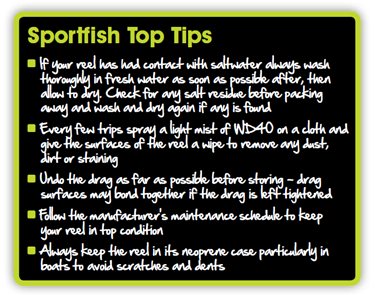
Fly Reel Top TipsThere are two main manufacturing processes used to produce fly reels and some reels rely on a combination to achieve the finished product.

  1. Die cast – This mass production process uses molten alloy poured or injected into a mould. It is generally used in less expensive reels and was a driving force in lowering the price of reels when it was introduced by Hardy’s early in the 20th century. Die casting allows manufacturers to produce forms that would be impossible to create with a machining process. The downsides to die casting are that it does not give such tight engineering tolerances and a reel dropped from height onto a hard surface may shatter.
  2. CNC machining – The majority of top end fly reels are made from computer numerical control machining of bar stock aerospace grade aluminium. Machined parts are then anodised to prevent corrosion making them resistant to saltwater. Reels manufactured in this way are lightweight, strong and will take a lot of punishment and wear. The materials and manufacturing process make reels made this way more expensive but with care and regular maintenance they should last a lifetime.

What species will you be fishing for?

This is the key question to ask yourself when choosing your new reel. For example, reel’s for salmon will need to offer enough capacity to hold a speycasting line and sufficient backing. One point to bear in mind here is that manufacturers often label reel models with sizes that relate to fly lines for single-handed rods, so a reel designed for a 10wt saltwater line will not take a 9/10 or 10/11 speycasting line and backing. Reels for light river trout or grayling fishing only need a simple click & pawl check – there is no need for a sophisticated disc drag and the extra weight penalty this brings. However, reels for saltwater fishing need to be corrosion resistant and here a reliable disc drag system is an indispensable asset.

What size reel is correct?

As explained above, the most important thing is that the reel offers the correct capacity to hold your fly line and backing. In addition, you need to factor in balance. The loaded reel should ideally balance the rod in your hand at the point where you grip the handle. This will make the rod feel light and remove any tip heavy feel from the outfit. There is also your personal preference – very small reels can feel fiddly if you have large hands. Use the information panel for each reel listed for specific information on size, weight and capacity.
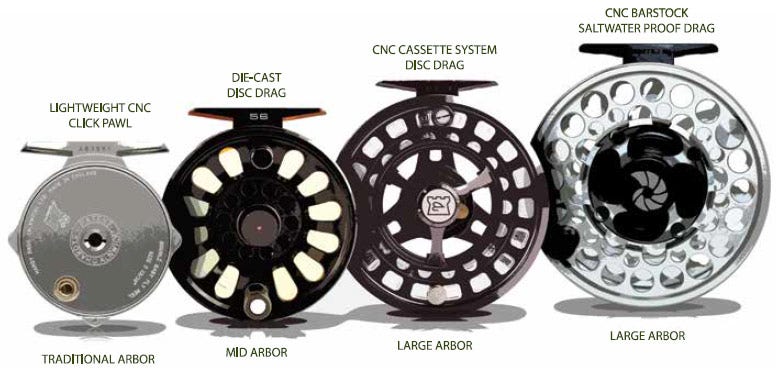


What reel design?

There are several types of fly reel on the market and each has been built with a particular use in mind. The type of fishing you are looking to do will determine which reel will suit you best. The 3 main designs of fly reel are detailed below. The arbor is the distance from the centre spindle to where the base of the spool starts.
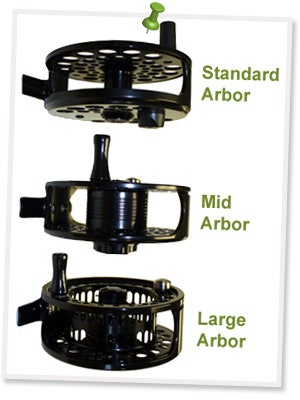
Fly Reel Types

Standard Arbor Fly Reels

With a SA reel the spools base (the part you attach the backing to) is in the middle of the reel. This is the traditional design of reel that is still favoured by some anglers for use with smaller river rods and traditional cane fly rods. They hold plenty of backing but on the down side the frames are often very narrow. The backing and the fly line is put on to the reel in very small diameter coils which reduces your retrieval rate per revolution and puts more coil memory into your fly line. Regardless of the quality of your line they make for poor line storage - the tighter the line is coiled, the more the line will suffer from coil memory.

Mid Arbor Fly Reels

A mid arbor is the middle ground of the 3, the base of the reel has been moved out slightly from the spindle in the middle and the reel has been widened to compensate. These reels have a good capacity for backing and keep the line in a larger loop to reduce memory and increase line retrieval rate. These have a lot more metal machined out to reduce weight.

Large Arbor Fly Reels

Large arbor are the most modern of reel designs, they are physically larger than the other 2 designs for the same line rating. They have a much bigger diameter and are wider in their design. This allows a good backing capacity, a very fast retrieval rate (with some reels being able to recover up to 14 inches per revolution) and subsequently a reduced line memory. For some more traditional anglers these reels just look too big for the rod but they are very light in weight and balance any size of rod perfectly. These reels are highly machined to reduce weight as much as possible without compromising structural stability.

What is a cassette fly reel?

This is a fly reel that uses inexpensive plastic spools. These can be easily exchanged to allow fly lines of different types and densities to be swapped over on the same reel. Most will come with a selection of spools in a purpose designed carry case and extra spools can be purchased as required. They are ideal for competition trout anglers, those on a budget and travelling anglers trying to reduce the weight of their kit.

What spool design?

For many years a fly reel would have a solid replacement spool, you would remove the whole spool and replace it with another. Often the cost of the spool would be roughly half the cost of the reel. A modern take on spare spools has been developed (courtesy of the competition match angler who would often be carrying as many a 20 different lines and spools). For the convenience of being able to carry lots of spools the cassette or cartridge reel was developed. The way that they work is a plastic spool will locate into the spool frame which will then pop into the frame in the same way as a conventional spool would.

What type of drag system?

There are two main types of drag found on fly reels.
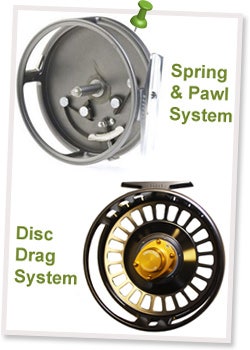
Reel Systems

Spring & Pawl

Traditional standard arbor designs tend to come with a “spring and pawl” or “click drag”. This is a simple cog mechanism that alters the amount of pressure applied to the spindle. There isn’t a big different between full and minimum drag.

The advantage of the S&P drag is that it weighs very little so reduces weight but has very little stopping power over large fish. This drag is ideal for small rivers or still waters.

Disc Drag

This is the most popular and modern type of drag system. This works as a brake, it increases the tension put on the reel as a fish tries to pull line off but maintains a low pressure when winding in. They work by either applying pressure to the inside of the spool (Tibor) or by having all of the braking done within a hub or housing (Nautilus). Disc drag systems are made of varying materials which include Cork, Carbon fibre, Titanium, Ceramic, Teflon and Rulon as the most popular.

The best disc drag systems are able to apply as much a 20lb+ of torque. There are 2 main types of DD system: sealed, such as the Nautilus NV range which are water tight and zero maintenance and non sealed drags such as the Tibor’s which require oiling and greasing to maintain performance. These reels are designed to take a lot of abuse and be used in the harshest of conditions with the strongest of fish, a must for the saltwater angler and salmon fisherman.

Is left or right hand wind correct for me? – I’m right handed

This is a question that can make normally calm and reasonable fly anglers get quite animated! There really isn’t a right or wrong but today the majority of right handed anglers will prefer to wind the reel with their left hand leaving the more dextrous right hand to cast and control the fly rod. With a double-handed rod it is less important as you will cast both sides with either hand up the rod. There are no rules – the choice is yours. Most reel’s are easily converted from LHW to RHW but it’s a good idea to have all your reels set up the same way!

Guide by Sportfish expert Jonathan Tomlinson STANIC

Still need help?

For more help and information on purchasing your new fly reel please contact Sportfish on 01544 327111 or email danny.north@sportfish.co.uk