WIN WITH MACKENZIE    Your chance to WIN an Atlas Fishing jacket Worth £549 - ENTER NOW

  10% OFF ORDERS    Black Friday Early Bird Deal, use code BF25EB for 10% OFF - VIEW DETAILS

 IT'S FREE FLY TIME   Buy Any 5 Flies, Get The Cheapest FREE* - SHOP NOW

  THE LATEST GEAR     Discover new tackle and clothing from the best brands - BROWSE NOW

  NEW 2025 CATALOGUE     Discover new tackle and clothing from the best brands - REQUEST A COPY

 GIFT VOUCHERS   don't forget, if you're stuck, there's always a Sportfish e-Voucher - SHOP VOUCHERS

  MID-SEASON SALE: UP TO 50% OFF    Grab a bargain on selected tackle & clothing - SHOP SALE

  EARLY BIRD SAVINGS*    10% OFF code 10EB26 or 15% OFF orders £200+ code 15EB26 - VIEW DETAILS

  FESTIVE DEALS    10% OFF* use code XMAS10 or 15% OFF* orders £250+ use code XMAS15 - VIEW TERMS*

  JANUARY SALE NOW ON    Save at least 30% OFF top brands - SHOP NOW

  LAST-MINUTE GIFTS    Explore Christmas gift ideas & order before 3pm on Mon 22nd Dec --SHOP NOW

   BLACK FRIDAY DEAL      15% OFF* with code BF15 or 20% OFF* orders £500+ use code BF20 - VIEW TERMS*

The Sportfish Expert's Guide to Choosing a Single-Handed Fly Fishing Rod

Beautiful brown trout laying on the riverside in water with single handed fly rodBeautiful brown trout laying on the riverside in water with single handed fly rod

Like most sports equipment fly fishing rods have been subjected to a huge amount of technological development in the last few years. The net result of this is the best range of rods we have ever stocked. Today’s rods are lighter and stronger than ever before with more feel and casting ability.

In simple terms, modern rods are constructed from carbon fibres held in place by resin, formed by wrapping carbon cloth around a mandrel applying the resin then baking the lot in an oven. The result of this is a long slim cone known as a blank. The blank is then ground to remove any unevenness created by the cloth being wrapped and fitted with a cork handle and reel seat. Rings (guides) are whipped on and then coated with a clear resin to protect them against the day to day wear and tear of fishing.

Man casting a single handed fly rod whilst in the riverMan casting a single handed fly rod whilst in the river

Single-Handed Fly Rods Guide

With an ever increasing availability of fly rod options, it can be hard to work out what fly rod might be right for your needs.

We’ve been selling fly rods for over 40 years and below have pulled together a comprehensive list of the most common questions we get asked:

  1. What sort of fly rod should I buy?
  2. Does my fly rod need to be a certain length?
  3. Do I need a single-handed, double-handed or a switch fly rod?
  4. What does the weight (#aftm) of a fly rod mean?
  5. What does fly rod action mean?
  6. Are some fly rods easier to cast than others?
  7. What is a good fly rod for a newcomer?
  8. What shape rod handle should I choose?
  9. What is a fighting butt on a fly rod?
  10. Can a fly rod cast any size flies?
  11. What are the most important factors when selecting a fly rod?

And here are the answers from our team of experts, which we hope will make the process of selecting a single-handed fly rod a bit easier for you.

If it’s a double-handed or switch fly rod you’re after then you can read our guide to choosing a double-handed fly rod.

Don't forget to also check out our general guide to fly rod jargon and FAQS!

1. WHAT SORT OF FLY ROD SHOULD I BUY?

There are 3 main factors to consider when choosing a new fly rod:

  • Where you will be fishing: if you’re fishing smaller rivers shorter rods (8ft and less) are better for accuracy, delicacy of presentation and manoeuvrability in restricted spaces, whereas if you’re fishing larger rivers or stillwaters then longer rods (9ft+) are better for longer casts and managing your fly line. Freshwater and saltwater rods also differ.
  • What fish you will be targeting: more powerful, heavier rods are best for bigger fish such as salmon, pike and big stillwater trout or casting bulky flies, whereas shorter, lighter rods are better for smaller fish such as river trout and casting more delicate fly patterns.
  • Your budget: price is usually a good indicator of quality, so try to get the best you can reasonably afford. It’s also a good idea to try before you buy to ensure the rod feels right for you, which you can do at both our Sportfish stores. However if you’re a beginner it’s best to go for something more budget friendly so you can upgrade as you get more experienced. Some of the ready to fish outfits are also great for beginners, and a good all round freshwater rod is a 9 ft 5 weight.

2. DOES MY FLY ROD NEED TO BE A CERTAIN LENGTH?

Yes, it does and it’s dependent on the type of fishing you’ll be doing:

  • Small streams & rivers (6–8ft): Shorter rods offer more accuracy, better fly presentation and are easier to cast in tight spaces, plus the fish are often smaller so your rod doesn’t need as much backbone
  • General river or small stillwaters (9–9½ft): Rods this length are very versatile as they’re capable of handling various sizes of dry flies, nymphs, wet flies and lures, plus their longer length allows for better casting reach and ability to fight larger fish
  • Larger rivers, reservoirs, and stillwaters (9½–10ft): These are generally the longest of the single handed rods and will provide even more distance, better line control, and fish fighting ability
  • Large river & lochs, salmon and sea trout (10–15ft): These longer of these rods (11-15ft) are usually double handed for specific techniques like Spey casting for salmon in big open spaces, whereas the shorter 10ft ones are usually single handed and used for loch style boat fishing, sea trout and salmon  
  • Saltwater and Predator (9ft): Powerful, reinforced rods designed for handling large saltwater species and casting big flies, these rods are typically constructed with saltwater-proof guides and reel seats

Freshwater Single-Handed Rods

Saltwater Single-Handed Rods

Large Reservoirs 9.5’ – 10’ 7/8 weight Flats Bonefish/UK saltwater 9’ 7/9 weight
Small Still waters 9’ – 9.5’ 5/6 weight Flats Permit/Baby tarpon 9’ 9/10 weight
Large rivers 9’ – 10’ 4/6 weight Big Tarpon/bluewater 9’ 11/13 weight
Small rivers/streams 7’- 8.5’ 2/5 weight Sailfish/Big Sharks/Tuna 9’/8.5’ 12/14 weight
Sea trout/Light salmon 10’ 7/8 weight  

3. DO I NEED A SINGLE-HANDED, DOUBLE-HANDED OR A SWITCH FLY ROD?

As above, this depends on the type of fly fishing that you’ll be doing:

Single-handed rods

Best for small to medium rivers, most stillwaters and saltwater fly fishing, they vary from 6ft to 10ft and are made to handle trout, reasonable sized salmon, pike, grayling, carp, and a variety of saltwater species and generally offer better presentation and accuracy, but less power and distance

Double-handed rods

Best for much larger rivers where you need to cast further (Spey, Scandi and Skagit casting), they range from 11ft to 16ft and can cast heavy lines and flies with less effort and offer better line control at range, ideal for bigger salmon and steelhead

Switch rods

Essentially these are just shorter, lighter double-handers that allow you to perform both anchor and overhead casts, they’re usually 10ft to 12ft and provide great versatility on small to medium sized rivers where you’re casting small to medium sized flies

4. WHAT DOES THE WEIGHT (#AFTM) OF A FLY ROD MEAN?

The AFTM (Association of Fishing Tackle Manufacturers) rating of a fly rod specifies the recommended fly line weight to be used with that particular rod, ensuring the rod performs at its best and loads correctly when casting.

The AFTM number is usually displayed by a “#” followed by a number and it corresponds to the weight in grains of the first 30 feet of a fly line. What AFTM weight fly rod you need will depend on the type of fishing you will be doing (the target fish, type of water, fishing conditions and size of fly).

  • AFTM #2 to #4: designed for lighter fly lines for smaller fish and delicate presentation, such as fishing for trout in small rivers or streams
  • AFTM #5 to #6: ideal for medium rivers or small stillwaters, and slightly larger trout, the heavier weight line allows for more reach when casting and the ability to handle larger flies
  • AFTM #7 to #9: for the larger rivers and stillwaters, plus most saltwater and pike fishing, heavier lines can cast even further, especially into the wind and can handle presenting bigger flies better, plus the rod is stronger allowing you to play bigger fish more easily
  • AFTM #10+: generally for salmon and big saltwater fish, or when using larger pike flies, these are the heaviest and most powerful rods

5. WHAT DOES FLY ROD ACTION MEAN?

Fly rod action describes two attributes of a fly rod that usually go together. Firstly, the speed that the rod straightens after being flexed (also known as recovery) is described as fast, medium or slow. Secondly, the way the rod bends when it is flexed - a rod can be tip action, middle-tip, middle or through action.

A fast action rod will normally bend most at the tip and less so through the rest of the blank, so tip and fast action go together as do through (bending throughout the rod) and slow action. Put simply:

  • Fast action: great for casting increased distances and for cutting through wind, and less physically demanding due to its inherent power, however more difficult for beginners to handle as the cast requires more precise timings, plus they aren’t ideal for close range fishing where accuracy and delicacy are paramount
  • Medium action: these are great all-rounders due to their versatility, good for beginners and capable of casting a wide range of flies and lines, but not great for the utmost distance or delicacy
  • Slow action: easiest to cast accurately and delicately, great for smaller rivers where you don’t need to cast far or use heavy flies

6. ARE SOME FLY RODS EASIER TO CAST THAN OTHERS?

Yes, some rods will be easier to cast than others, especially if you’re a beginner, but these days thanks to modern technology most fly rods can be fairly easily cast. There are a few factors to consider though:

  • Rod action: medium action rods are best for beginners as they offer the most versatility, they bend down the middle of the rod blank making it more forgiving and providing a better feel for when the rod is properly loaded with the line and making the timing of the cast easier. Fast action rods generate higher line speeds and therefore allow more distance when casting but require better timing and experience
  • Rod weight (line # rating): heavier weighted rods make it easier to cast heavy flies, whereas lighter weighted rods require less power to cast
  • Rod length: shorter rods are easier to cast in overgrown areas, whereas longer rods can cast further and offer better line control

7. WHAT IS A GOOD FLY ROD FOR A NEWCOMER?

As with most questions relating to fly rods, the answer very much depends on the type of fishing you’ll mainly be doing (especially target fish and type of water). In general, you should try and get the best quality rod your budget can afford, but save the more expensive options for when you have more experience and ability, or may need specific rods to cover specific types of fishing.

  • Most versatile: a 9ft #5 weight fly rod with a medium-fast action will cover the majority of UK trout fishing that a beginner might do, as it can work for rivers and small stillwaters, cast a variety of different style flies (dry, wet, nymph, lure) of varying sizes, plus its length and action make it the easiest to cast. It’s the most practical choice if you only own one fly rod as it allows you to do more different styles of fishing on more varied types of water and target most fish
  • Small rivers: if you’re only going to be fishing on smaller rivers then you might want to consider something smaller and less powerful, such as an 8ft #4 weight, its shorter size making it easier to cast in restricted areas and allowing for the more delicate fly presentation and accuracy required on this type of water
  • Larger stillwaters: if however most of your fishing will be on bigger stillwaters then you may benefit from a slightly longer and more powerful rod such as a 10ft #7, which allows you to cast further and better control your line, as well as deal with playing bigger fish. This type of rod is also perfect for river pike fishing.
  • Salmon: if you’re after your first rod for salmon and you’re fishing big rivers, you should probably consider a double-handed rod around 13ft, or possibly a switch rod of shorter length (11ft) for more fishing versatility
  • Beginner kits / combos: there are a number of great quality fly fishing kits that combine a rod with a matched reel and fly line and which represent great value as a starter kit

8. WHAT SHAPE ROD HANDLE SHOULD I CHOOSE?

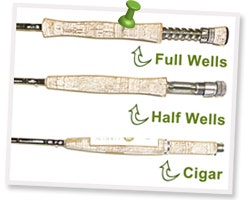
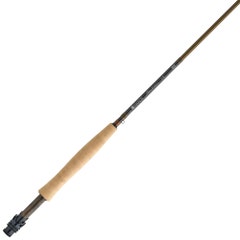
Single-Handed Rod HandlesMost fly fishing rod handles are made of cork - cork feels great in the hand and is easy to grip if your hands are cold and wet. Everyone has different hands so the short answer is whatever feels most comfortable for you and helps your casting. That said, of the three main rod handle shapes, some believe that they lend themselves better to different purposes:

  • Full Wells: humped in the middle to fit the palm with flares at both ends, many prefer this for distance casting, usually found on longer and more powerful rods
  • Half Wells: more of a taper at the rod end, many prefer this style for greater comfort and control when fishing smaller waters
  • Cigar: shaped like a cigar with tapers at both ends, generally found on the much lighter rods

9. WHAT IS A FIGHTING BUTT ON A FLY ROD?

A fighting butt is a short extension to the fly rod below the reel seat, designed to provide increased leverage when fighting bigger fish and allowing some degree of double-handed casting. It offers anglers several benefits over a standard single-handed fly rod, depending on the type of fishing you’re doing:

  • Improved fish fighting power: instead of relying solely on your arm, it allows you to use your lower body as a fulcrum point to apply maximum pressure when fighting powerful fish such as salmon, steelhead and most saltwater species
  • More comfortable: cushioning the rod against your body is less tiring than only using your arm, useful when you have to play fish for longer, plus because the reel is further from you it means loose clothing won’t get in its way
  • Better balanced rod: adding a small bit of weight to the end of the rod can help balance out tip heavy or long rods
  • Greater versatility: a fighting butt allows both single-handed and a degree of double-handed casting, meaning it can be used in more situations and for more types of fishing
Guide to Choosing a Single Handed Fly RodGuide to Choosing a Single Handed Fly Rod

10. CAN A FLY ROD CAST ANY SIZE FLIES?

The short answer is no, not all fly rods can cast any size fly. Fly rods are designed with different lengths and power for different types of fishing (where fly size can vary hugely), and what flies can be cast will be dependent on:

  • Rod AFTM rating: rods with higher AFTM ratings (#6+) are more powerful and thus much better at casting heavier and bigger flies, whereas rods with lower AFTM ratings (#2 to #4) can cast smaller flies with much more delicacy and accuracy
  • Rod action:  faster action rods make bigger flies easier to cast, however slower action rods allow for more controlled fly presentation
  • Rod length: longer rods are generally more powerful than shorter ones, permitting a greater variety of size flies to be cast, but shorter rods are much better at casting smaller flies (the exception here is saltwater & predator fly rods which are usually 9ft but with much heavier AFTM ratings than most 9ft rods)
  • Fly size & weight: although not always heavier, bulkier flies have more wind resistance making them more difficult to cast without sufficient rod power

11. WHAT ARE THE MOST IMPORTANT FACTORS WHEN SELECTING A FLY ROD?

Provided you’re a competent caster, the single most important factor is matching the fly rod (length, AFTM # rating, rod action) to the type of fishing that you’ll be doing (type of water, target fish, style of fishing). Once you’ve worked out what rod will be most suitable then you can look at what’s available in your budget range. Start with working out what type of fishing you’ll be doing and match the rod as below:

  • Type of water: if you’re fishing smaller rivers then shorter rods (8ft and less) with lower AFTM rating (#2 to #4) and a medium or slow rod action are better for accuracy, delicacy of presentation and manoeuvrability in restricted spaces. If you’re fishing larger rivers or stillwaters then longer rods (9ft+) with a heavier AFTM rating (#5 to #7) and a medium or fast action are better for longer casts and managing your fly line. And if you’re fishing the really big rivers or stillwaters then you’ll be looking at rods around 10ft with AFTM ratings #7+
  • Target fish: more powerful (higher AFTM rating) and longer rods (9ft+) are best for bigger fish such as salmon, pike and big trout or casting bulky flies, whereas shorter (9ft or under), lighter (lower AFTM ratings) rods are better for smaller fish such as river trout & grayling and casting more delicate fly patterns
  • Style of fishing: certain types of fishing such as Euro nymphing benefit from slightly longer rods, and fishing using heavy streamers requires a rod with a bit more power (a higher AFTM rating). If you’re salmon fishing on the big rivers then you should consider a double-handed rod for Spey casting, and if you want a single versatile rod because you want to fish different styles and be able to do a bit of overhead and anchor casting then you might want to consider a switch rod
  • Your budget: price is usually a good indicator of quality, so try to get the best you can reasonably afford. It’s also a good idea to try before you buy to ensure the rod feels right for you, which you can do at both our Sportfish stores. However if you’re a beginner it’s best to go for something more budget-friendly so you can upgrade as you get more experienced. Some of the ready-to-fish outfits are also great for beginners, and a good all-round freshwater rod is a 9 ft 5 weight.
Woman holding two single handed fly rods with blue sky in the backgroundWoman holding two single handed fly rods with blue sky in the background

Guide by Sportfish expert Chris Ryan

Still need help?

Give our friendly team a call on 01544 327111 and don’t forget you can try before you buy on the water at both our Sportfish stores and book casting tuition at the Sportfish Game Fishing Centre.


Discover Our Single-Handed Fly Rods